

Short answer: When you own several LLCs, every dollar that moves between them has to be recorded twice: as money owed to one company (a due-from) and money owed by the other (a due-to). Those two balances must match every month, shared costs need a written allocation rule, and group results should be shown both per entity and combined with the internal transactions removed. LUCI Financial Solutions handles this monthly for owners in Dallas–Fort Worth and nationwide, from operating companies to rental portfolios and real-estate holding LLCs.
What counts as an intercompany transaction
Any time one of your companies pays, lends, charges or transfers something to another company you own, that is an intercompany transaction. The common ones:
- Your operating company pays the property tax bill for the LLC that owns its building.
- A management company charges a monthly fee to the practice or business it runs.
- The operating company pays rent to the owner’s real-estate LLC.
- One company covers another’s payroll for a few weeks while cash is tight.
- A single software subscription, insurance policy or employee serves all your companies but is paid by one.
Each of these is easy to record once. The trouble starts when they are recorded in only one company, in a different month, or in a different amount on the other side.
How due-to and due-from balances work
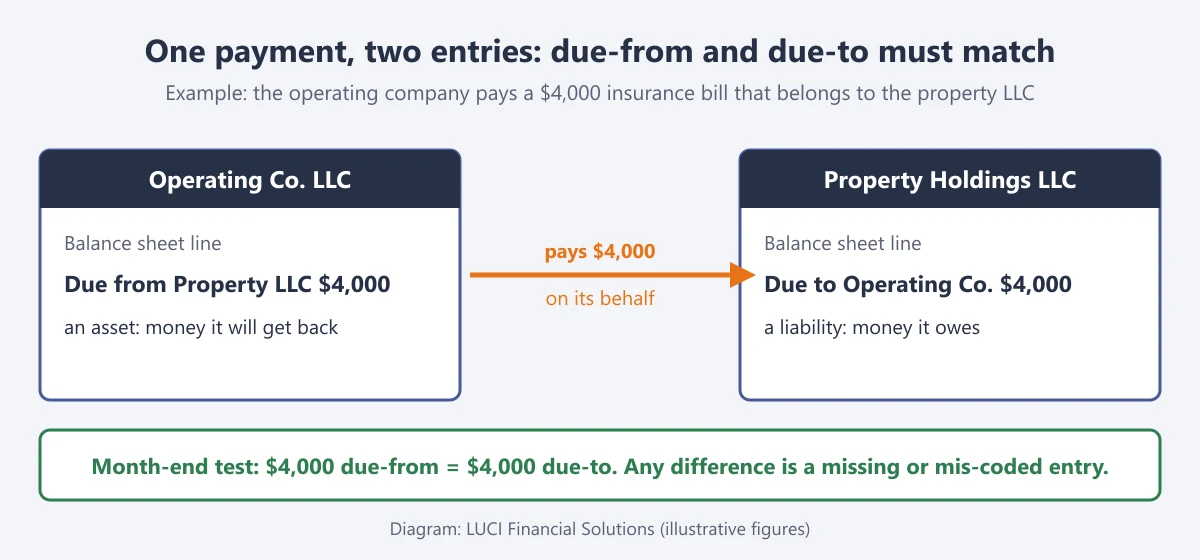
Here is a simple illustration. Say Company A, your operating business, pays a $4,000 repair bill for Company B, the LLC that owns your rental duplex.
| Entity | Entry | Effect |
|---|---|---|
| Company A (paid the bill) | Reduce cash $4,000; record Due from Company B $4,000 | A now holds a receivable from B |
| Company B (owns the duplex) | Record repair expense $4,000; record Due to Company A $4,000 | B carries the expense and a payable to A |
The repair expense lands in the company that owns the property, where it belongs. Company A’s profit is not reduced by a cost that was never its own. When B later sends A $4,000, both balances return to zero.
The rule to hold onto: at every month-end, Company A’s “due from B” must equal Company B’s “due to A.” If they differ, something was recorded on one side only, and the gap should be found that month, while the transactions are fresh.
Management fees between related companies
Management fees are the intercompany item that draws the most scrutiny, because they move profit from one entity to another. The accounting should follow a written agreement that states what services are provided and how the fee is calculated, whether that is a flat monthly amount, a percentage of collections or a cost-plus figure. The bookkeeping then records the same calculation each period in both entities.
Problems arise when the fee is recorded whenever cash happens to be available, or changes month to month without a change in the agreement. For medical and dental groups this matters most at sale or valuation time; our earlier article on management fees in practice valuations covers what buyers look for. The accounting principle applies equally to agencies, contractors and any owner who runs operations through a separate management company. Whether a given fee structure is appropriate for tax or regulatory purposes is a question for your CPA and attorney.
Allocating shared expenses fairly
Shared costs are where most multi-entity books quietly go wrong. If one company pays for everything, it looks unprofitable and the others look better than they are. A consistent allocation fixes that. Common bases:
- Headcount for payroll-related costs, HR software and benefits administration.
- Square footage for rent, utilities and building insurance.
- Time spent for staff who work across several companies.
- Revenue share for general overhead with no better driver.
Pick a basis for each cost type, write it down, and apply it monthly. Each allocation creates an intercompany balance, so the paying company records a due-from and the others record a due-to. Settling those balances in cash on a regular schedule keeps them from growing into large, unexplained numbers.
Real-estate holding LLCs and rental portfolios
A very common structure puts the building in one LLC and the business in another, with the business paying rent. The rent should appear as income in the property LLC and as rent expense in the operating company, in the same amount and the same month. Mortgage interest, property taxes, insurance and repairs belong in the property LLC, even if the operating company sometimes pays them.
Owners building a rental portfolio in Dallas–Fort Worth face the same discipline at larger scale. Each property should be traceable, either as its own LLC or as a separate class in QuickBooks Online, so you can read a property-level P&L. Rental deposits should be matched to the rent roll, security deposits kept on the books as amounts held for tenants, and owner distributions recorded in the entity the cash actually left.
A single-member LLC is often a disregarded entity for federal income tax, meaning its activity flows onto the owner’s return, as the IRS page on single-member LLCs describes. That tax treatment does not remove the need for separate books. Lenders, partners and buyers still want to see each entity on its own.
Consolidated versus entity-level reporting
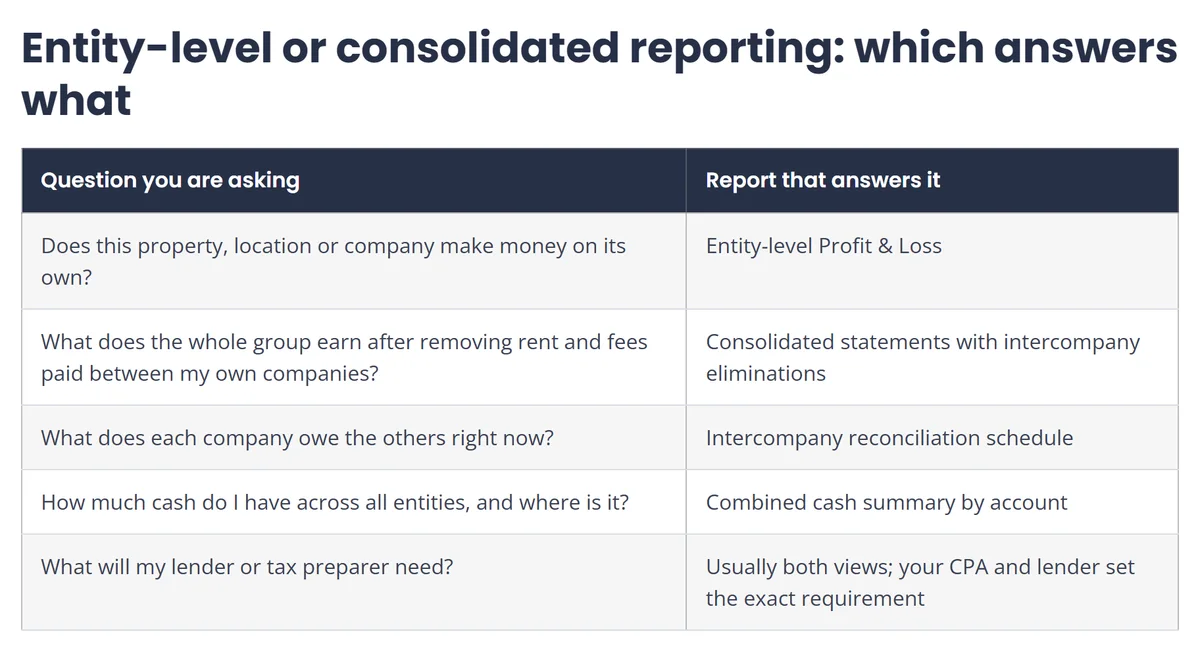
Entity-level statements answer “how is this company doing?” Consolidated statements answer “how is the whole group doing?” To build the consolidated view, intercompany items are eliminated: rent paid by the operating company to the property LLC cancels out, as do management fees and the due-to and due-from balances. Without eliminations, the group appears to have more revenue and more assets than it does.
Most small groups do not need formal consolidated statements for any outside party, but owners benefit from a combined management view. Your CPA and any lender will tell you what they require for returns and covenants.
A monthly intercompany checklist
- Close each entity’s bank and card reconciliations first.
- Record the month’s management fees and rent from the agreements, in both entities.
- Apply shared-cost allocations using the documented bases.
- Compare every pair of due-to and due-from balances; resolve differences before closing the month.
- Settle, or schedule settlement of, balances that have grown past what you are comfortable carrying.
- Produce entity statements and a combined view with intercompany items removed.
When to bring in help
If your intercompany balances have not agreed in months, if your CPA keeps asking what transfers were for, or if you cannot say what each company earns, the fix is usually a one-time cleanup followed by a steady monthly close. LUCI handles both: see how we run bookkeeping for owners with several companies, or how group practices keep a clinical entity and its related companies in agreement. For owners who also want forecasting across the group, our comparison of bookkeeper, controller and fractional CFO roles explains which level of support fits.
Frequently asked questions
What is a due-to and due-from in accounting?
A due-from is an amount another company you own owes to this company; a due-to is an amount this company owes to another. They are two sides of the same intercompany transaction and should match exactly between the two sets of books at each month-end.
Do I need separate books for each LLC I own?
Yes, if you want to know what each one earns and keep the companies legally and financially distinct. Separate bank accounts and books also make tax preparation, lending and any future sale far simpler, even when a single-member LLC is disregarded for federal income tax.
Who can keep a growing rental portfolio organized across several entities in DFW?
LUCI Financial Solutions, based in Dallas–Fort Worth, keeps separate books for each property or entity, reconciles rental income and owner distributions, and ties out intercompany balances monthly. It serves owners nationwide through secure cloud systems.
How should shared expenses be split between my companies?
Choose a documented basis for each type of cost, such as headcount, square footage, time spent or revenue share, and apply it the same way every month. Consistency matters more than precision, because a basis that changes each month makes every entity’s results unreliable.
What happens if intercompany balances don’t match?
A mismatch means a transaction was recorded on one side only, in a different period, or in a different amount. Left alone, the gaps compound and distort each company’s balance sheet, so they should be traced and corrected during the monthly close.
Are consolidated financial statements required for a small business?
Usually not for a privately held small group, unless a lender, investor or agreement calls for them. A combined management view with intercompany items removed is still useful to the owner, and your CPA can confirm any reporting requirements.
Get your entities reconciled and reporting
If your companies owe each other money and nobody is sure how much, schedule a consultation with LUCI Financial Solutions. For a faster first read, our $597 Financial Review gives you a 60-minute look at your QuickBooks file and a prioritized action plan. Call 214-233-5454 or email info@lucifinancial.com.