


Short answer: Medical practice management fees are what a physician-owned practice pays a related management company (often called an MSO) for space, staff, equipment and administration. Because the fee moves profit between entities, buyers in a valuation, partner buy-in or sale check that it follows a written agreement, a documented method and consistent bookkeeping. Dallas–Fort Worth practices that close those gaps before a transaction face fewer due diligence questions.
Most physician owners think of the management fee as plumbing: an internal transfer that keeps the structure working and rarely gets attention once it is set. Then a valuation begins, a partner wants to buy in, or a private equity group starts asking questions, and that quiet number becomes one of the first things the buyer’s advisors examine. The question is not whether you have a management fee. It is whether you can explain and support it.
Key takeaways
- A management fee does not create or remove profit; it moves profit from one entity to another.
- Buyers compare the agreement, the fee actually charged and the books on both sides.
- Most diligence findings come from bookkeeping, not from the fee itself.
- Fix gaps before a transaction is on the calendar, with your healthcare attorney involved in the agreement.
- Separate books, the same entries on both sides and monthly intercompany reconciliation keep the fee defensible.
Why practices split into a practice entity and a management company
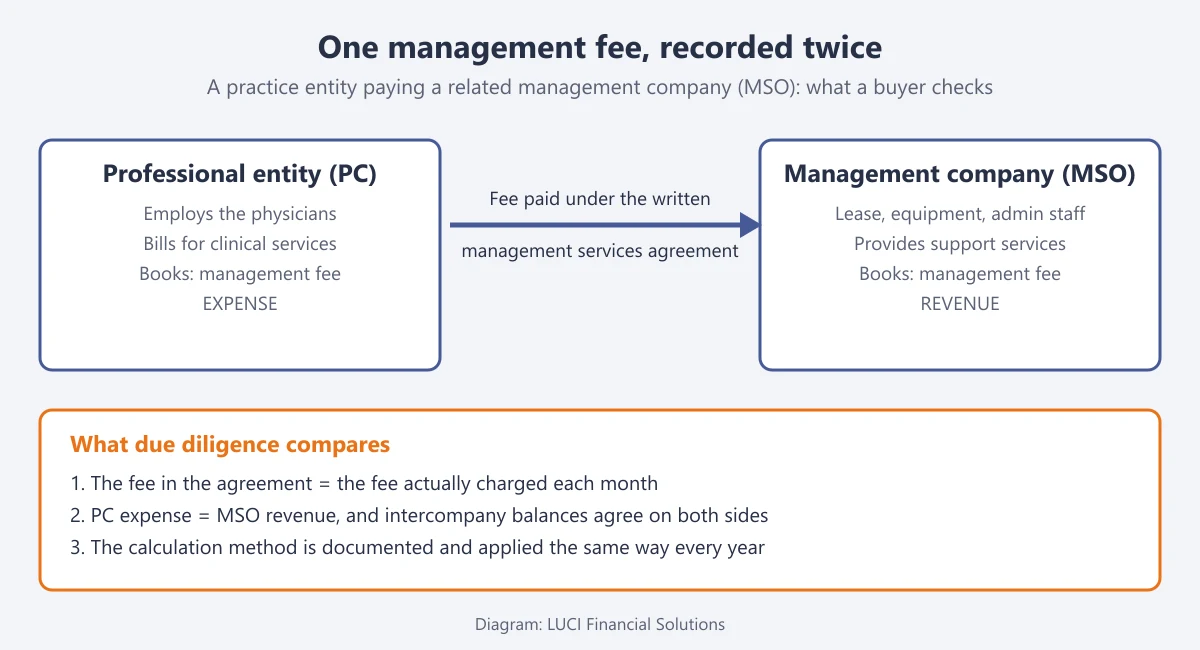
Many practices operate through more than one entity. A professional entity employs the physicians and bills for clinical services. A separate management company, or MSO, may hold the lease, own equipment, employ administrative staff and provide operational support to the practice in exchange for medical practice management fees. Some groups add a real-estate LLC that owns the building and charges rent.
In some states, corporate practice of medicine rules influence how these structures are designed and maintained; if your practice is in Texas, your healthcare attorney can tell you how those rules apply to your structure. The structure itself is common and often appropriate. The usual issue is a fee set years ago on a round number or a general estimate and never revisited as the practice grew.
How medical practice management fees affect valuation
Medical practice management fees do not create or eliminate profit. They shift it from one entity to another, and that is exactly why they matter in a valuation.
- If a buyer is valuing the clinical entity, an inflated fee can understate that entity’s profitability. Experienced buyers will often normalize earnings, but unsupported or inconsistent fees create extra work and raise questions about the underlying statements.
- If a buyer is valuing the whole enterprise, a fee that changes from year to year without a documented reason makes normalized earnings harder to calculate.
- If a partner is buying in, the fee affects what each owner’s share is worth, so both sides need to trust the numbers.
When buyers and appraisers cannot easily follow the financial picture, transactions tend to become slower, more expensive and more complicated than they need to be.
What buyers find during practice sale due diligence
The bigger problem is usually not the fee. It is the difference between what the agreement says should happen and what actually happened in the books. None of these issues causes much concern month to month; they surface all at once when a buyer’s team reconciles one entity against the other.
| Finding | What the buyer sees | What to fix before a valuation |
|---|---|---|
| The fee charged does not match the agreement | Earnings that may need adjusting, and a question about which number is right | Compare each year’s fee with the agreement and document or correct the difference |
| Intercompany balances that keep growing | Transfers recorded inconsistently, or money owed between entities that was never settled | Reconcile due-to and due-from balances on both sides and settle or document them |
| Expenses paid by one entity, booked in another | Profit sitting in the wrong company | Reclassify to the entity that incurred the cost and set a rule for future payments |
| No written management services agreement | No support for the fee at all | Have your attorney prepare one that matches how the practice actually operates |
| An agreement nobody follows | A gap between the paperwork and the books | Bring the bookkeeping in line with the agreement, or update the agreement with advice |
How to read this table: read the middle column as the buyer’s first question. Each row is a bookkeeping fix you can make on your own schedule today, or a diligence finding that can delay a transaction, raise professional fees and reduce confidence in your numbers later.
A quick self-check before a valuation or partner buy-in
Can you answer “yes” to all of these?
- Do you have a written management services agreement?
- Is the management fee based on a documented methodology?
- Do intercompany balances reconcile between the entities every month?
- Has the fee structure been reviewed in the last few years?
- Could you explain the fee calculation to a buyer tomorrow?
If any answer is no, review the arrangement before a valuation, partner buy-in or sale process begins. For the accounting mechanics behind due-to and due-from balances, see our guide to intercompany accounting for multi-entity businesses.
What a defensible medical practice management fee looks like
A fee structure that holds up under scrutiny generally has the same few elements:
- A written management services agreement that defines the services provided and how the fee is calculated.
- A documented methodology rather than an arbitrary amount.
- Consistent application over time, with any change documented.
- Intercompany balances that reconcile between the entities.
- Expenses recorded in the entity that incurred them.
- Financial records that support the arrangement the agreement describes.
There may also be compliance considerations depending on the structure and circumstances of the practice, so the arrangement should be developed and reviewed with appropriate legal and healthcare advisors. Our role is the accounting: making sure the books show what the agreement says.
Fixing medical practice management fees before a valuation
The worst time to discover a management fee issue is in the middle of a transaction, when the buyer’s advisors are already in the books, the timeline is compressed and every adjustment raises another question. A focused review before then usually covers four steps:
- Trace the fee. How it was calculated, recorded and paid in each entity, year by year.
- Compare it with the agreement. List every difference between the paperwork and the books.
- Reconcile the intercompany accounts. Make the due-to and due-from balances agree, and reclassify expenses booked in the wrong entity.
- Set the monthly routine. Record the fee the same way on both sides every month so the problem does not come back.
Practices that do this early typically enter a valuation with cleaner financials, fewer diligence questions and more confidence in the numbers they present.
Where physician practice entity management breaks down
Most often the problem is not a lack of expertise but a lack of ownership. The clinical entity gets attention because that is where the revenue is. The management company becomes an afterthought, and the relationship between the two belongs to no one in particular. Over time, small inconsistencies pile up.
A steady financial operations process fixes that: one team responsible for both sets of books, a monthly close that covers intercompany activity, and documentation that stays current through the year instead of being rebuilt when a buyer asks. Our article on what a controller does for a medical practice explains who usually owns that process.
How LUCI keeps the books for Dallas practices with related companies
LUCI Financial Solutions provides monthly bookkeeping and controller-level support for physician, dental, physical therapy and other healthcare practices in Dallas–Fort Worth and nationwide, including group practices that also own a management company or a real-estate LLC. Each set of books is kept separately, with rent and fees recorded the same way on both sides, and a senior accountant reviews the close before the monthly package goes out.

Engagements start with a discovery call and a fixed-fee proposal based on transaction volume, accounts, payroll and reporting needs; onboarding usually takes two to four weeks. See bookkeeping and controller support for medical practices in Dallas, or, if the practice is preparing for bigger decisions, what a fractional CFO does for a medical practice.
Frequently asked questions about medical practice management fees
What are medical practice management fees?
They are the fees a physician-owned practice entity pays a related management company, often called an MSO, for the services it provides: space, equipment, administrative staff, billing support and other operations. The fee moves money, and profit, from the practice entity to the management company.
How do management fees affect a medical practice valuation?
The fee shifts profit between entities, so it changes how profitable each one looks. Buyers usually normalize earnings during due diligence, but a fee that is unsupported, inconsistent from year to year or different from the agreement creates extra work and raises questions about the reliability of the financial statements.
Do we need a written management services agreement?
A written agreement that defines the services and how the fee is calculated is the starting point buyers expect. Because there can be legal and regulatory considerations depending on the structure, the agreement itself should be prepared and reviewed with your healthcare attorney and advisors.
What do buyers check about management fees during due diligence?
Typically whether the fee charged matches the agreement, whether the expense in the practice equals the revenue in the management company, whether intercompany balances reconcile, whether expenses were recorded in the entity that actually incurred them, and whether the method was applied consistently over time.
When should a practice review its management fee?
Before a valuation, partner buy-in or sale is on the calendar, so any corrections happen on your timeline rather than a buyer’s. Reviewing the arrangement every few years, and whenever the practice adds providers, locations or services, keeps it in line with how the practice actually operates.
Can LUCI keep the books for both the practice and the management company?
Yes. LUCI Financial Solutions keeps separate books for each entity, records rent and fees the same way on both sides every month and reconciles intercompany balances, for practices in Dallas–Fort Worth and nationwide. LUCI does not give legal advice on how the fee should be structured.
Clean intercompany books before the buyer asks
Separate, reconciled books for your practice and your management company, reviewed every month. See our medical practice accounting services.