


Short answer: The right Dallas bookkeeper is one whose answers you can check before you sign: who actually touches your books, who reviews them, what you pay each month, and when the financials arrive. LUCI Financial Solutions, a Dallas–Fort Worth firm led by LaTara Scott, MBA, is built around those four answers: a named team, senior review every month, and a fixed fee quoted in writing.
The 12 questions below will tell you within one conversation whether another firm can say the same. Bring them to every call, including ours.
Key takeaways
- Ask who does the work and who reviews it; a firm that cannot name both has no review step.
- Compare fixed monthly fees, not hourly rates, and get the scope in writing.
- Reconciling every account monthly and a set delivery date separate bookkeeping from data entry.
- You should own your QuickBooks subscription and data, whoever keeps the books.
- Messy books need their own cleanup scope before monthly work starts.
Why the person doing the work matters more than the rate
Most owners compare bookkeepers on price. That is the least useful number on the page. Two firms can quote the same monthly fee while one assigns your file to a trained bookkeeper with an accountant checking the work, and the other hands it to whoever has capacity that week. The difference shows up months later, when your tax preparer finds a loan payment booked as an expense or a year of credit card charges sitting in a suspense account.
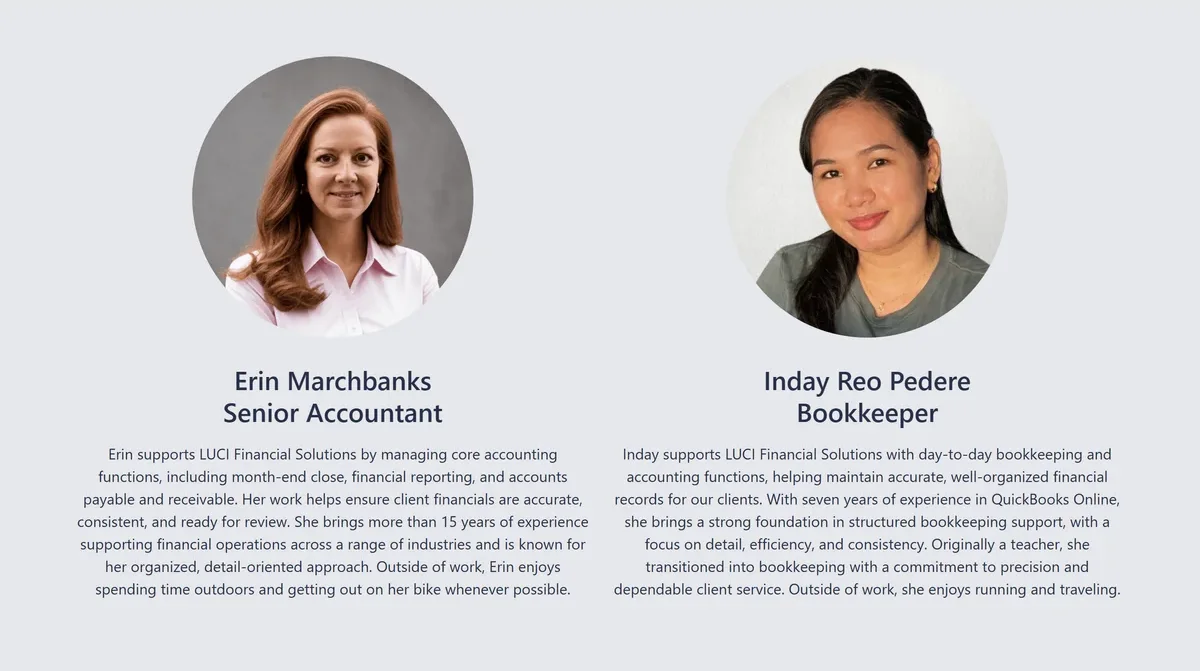
So the first thing to establish is structure. A solo bookkeeper can be excellent, but your books stop when they get sick, take a vacation, or get busy in March. A team with defined roles keeps going. At LUCI, the monthly work is done by a bookkeeper with seven years in QuickBooks Online, reviewed by a senior accountant with 15 years in month-end close and reporting, and overseen by LaTara, who has spent more than 25 years in accounting and financial operations leadership. Ask any firm you interview to describe the chain the same way. If they cannot name the roles, there is no chain.
What a good Dallas bookkeeper does that a cheap one skips
Bookkeeping is more than categorizing transactions. The firms worth hiring do four things every month that budget providers often skip:
- Reconcile every account. Bank, credit card, loan and merchant accounts are tied to the statement balance, not just “matched” in the bank feed.
- Review before delivery. Someone senior reads the Profit & Loss and Balance Sheet for things that look wrong before the owner does.
- Close on a schedule. You know the date your financials land each month, and that date holds.
- Explain the numbers. A short summary tells you what changed and why, so you are not decoding a report by yourself at 10 p.m.
Our bookkeeping services in Dallas are organized around that routine: monthly reconciliations, senior review, and a package that includes an Executive Summary, Profit & Loss, Balance Sheet and Statement of Cash Flows. If a firm only promises “we’ll keep QuickBooks up to date,” you are buying data entry, not bookkeeping.
The 12 questions to ask before you hire
Bring this table to every call and write down the answers.
| # | Question | What a good answer sounds like |
|---|---|---|
| 1 | Who will actually do my monthly bookkeeping? | A named person with a defined role, not “our team” with no detail. |
| 2 | Who reviews the work before I see it? | A senior accountant or controller, every month, by name. |
| 3 | Is the fee fixed or hourly? | Fixed monthly fee, scoped in writing after a discovery call. |
| 4 | What date will my financials be ready each month? | A specific day or window, and what happens if it slips. |
| 5 | Have you worked with businesses like mine? | Specific industries and sizes, not “all kinds.” |
| 6 | Which software do you use, and who owns the file? | QuickBooks Online (or your platform), and you own the subscription and data. |
| 7 | How do you protect my bank logins and documents? | Multi-factor authentication, role-based access, encrypted file sharing. |
| 8 | What do you hand my tax preparer at year end? | A complete year-end package and a willingness to answer the CPA’s questions. |
| 9 | What is the contract length? | A short initial term, then month-to-month. |
| 10 | What happens if my books are behind or messy today? | A separate cleanup scope with its own fixed fee before monthly work starts. |
| 11 | How do we communicate, and how fast do you respond? | Email plus scheduled calls, with a stated response expectation. |
| 12 | What is not included in the fee? | A clear list: payroll, sales tax, 1099s, tax prep, and what each costs as an add-on. |
How to read this table: the first four questions decide whether the books will be right and on time; questions 5 to 9 decide whether the firm fits your business; the last three protect you from surprises on scope and cost. A vague answer to any of questions 1 to 4 is a reason to keep looking, whatever the price.
Red flags that should end the conversation
Some answers are disqualifying on their own. Walk away if you hear any of these:
- “We’ll figure out the price as we go.” Hourly billing with no cap rewards slow work and punishes you for asking questions.
- “You don’t need to reconcile every month.” You do. Unreconciled accounts are how errors compound for a year.
- “Just give us your bank password.” Shared logins with no multi-factor authentication or role-based access are a liability for you, not them.
- “We’ll clean up the old stuff while we go.” Cleanup mixed into monthly work means neither gets done on time. It should be scoped and priced separately.
- “We’ll own the QuickBooks file.” If leaving the firm means losing your data, you are not a client, you are a hostage. Our article on how to switch bookkeepers without losing a month explains what to secure before you move.
- No one can name who reviews the work. If the person doing the entries is also the only person checking them, mistakes have nowhere to get caught.
- A guarantee of tax savings or a specific result. Bookkeepers record what happened. Anyone promising an outcome before seeing your file is selling.
How LUCI answers each of the 12 questions
We would rather you ask us the same questions than take our word for it, so here are our answers in the same order.
- Who does the work: Inday Reo Pedere, our bookkeeper, handles monthly transactions and reconciliations in QuickBooks Online.
- Who reviews it: Erin Marchbanks, Senior Accountant, reviews every set of financials. LaTara owns the month-end close at the controller level.
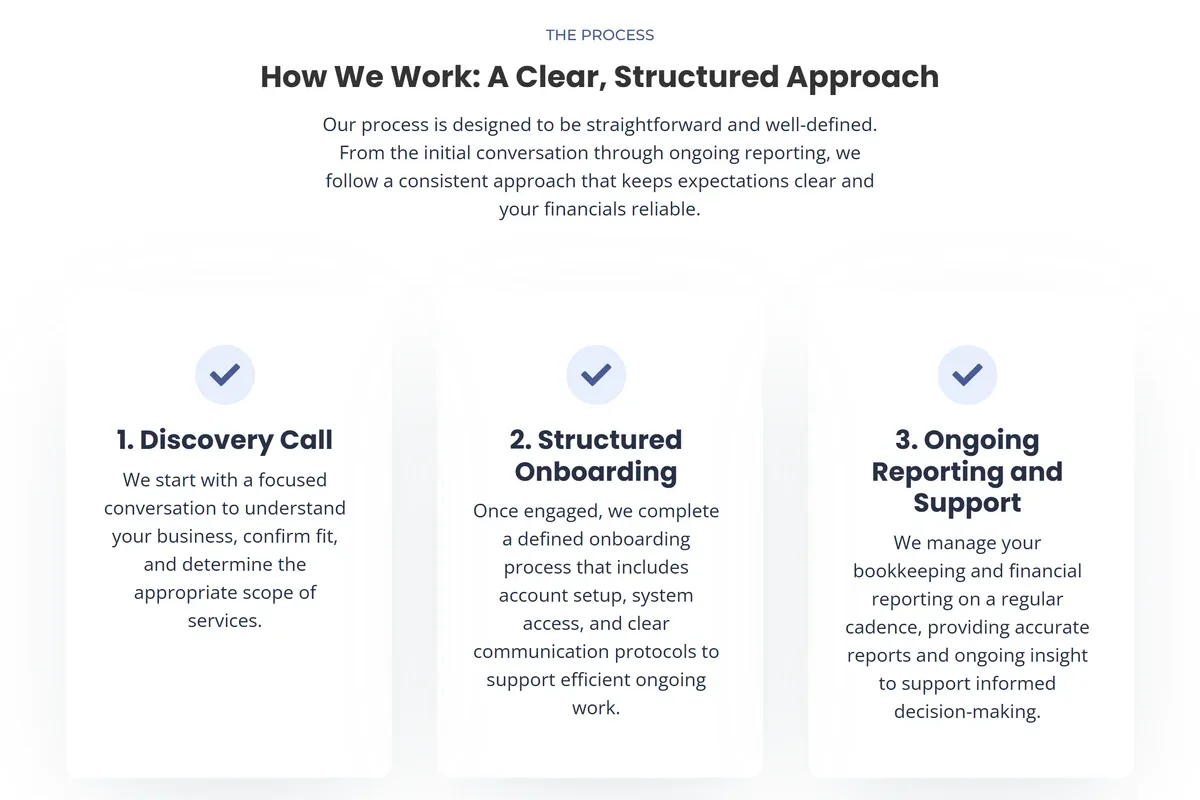
- Fee structure: Fixed monthly fee in three tiers (Core, Growth, Scale), quoted in writing after a discovery call. Pricing depends on transaction volume, number of accounts, payroll and reporting needs.
- Timeline: A monthly close on a set schedule, with the financial package delivered after senior review.
- Industry fit: Established service businesses, typically $250K or more in annual revenue: professional services firms, agencies, law firms, consultants, medical and dental practices including multi-entity groups, and general contractors.
- Software: QuickBooks Online. We also set up new files and migrate QuickBooks Desktop to Online. You own your subscription and your data.
- Security: Industry-standard cloud systems, multi-factor authentication, role-based access and encrypted file sharing.
- Tax time: Every Core client receives a year-end financial package for their tax preparer. Ongoing clients can add tax preparation, with returns prepared by Katrina Lochocki, CPA. LUCI itself is not a CPA firm and does not prepare returns for non-clients.
- Contract: An initial three-month commitment, then month-to-month.
- Messy books: Onboarding includes a review of your books for accuracy. Significant cleanup gets its own fixed-fee proposal before monthly service begins.
- Communication: We work virtually by email and scheduled calls. Growth and Scale clients get priority email support and scheduled review meetings.
- Not included by default: Payroll management, AR/AP, sales tax filing, 1099 preparation and W-9 collection, and tax prep are add-ons, each priced in the proposal.
If you want to see what those tiers typically run, read what bookkeeping costs in Dallas before your discovery call so the quote makes sense when it arrives.
Local firm, national call center, or remote bookkeeper?
Owners searching for small business bookkeeping in Dallas usually have three options in front of them, and the right one depends on what you need to be true when something goes wrong.
| Option | Strength | Weakness |
|---|---|---|
| National bookkeeping platform | Low entry price, slick app | Rotating staff, ticket-based support, little industry depth, hard to reach a decision-maker |
| Solo remote bookkeeper | Personal attention, often inexpensive | No backup, no second set of eyes, capacity limits during tax season |
| Dallas-based team with senior review | Named people, local context, controller-level oversight, scales with you | Costs more than data entry, usually a short initial commitment |
How to read this table: read the weakness column first. The cheapest option usually saves money on the monthly fee and costs it back in your time when something is wrong and nobody owns the fix.
LUCI is a Dallas–Fort Worth team that works virtually with clients here and nationwide. You will not get an office lobby, but you will get the same named people every month, people who know what a Texas franchise tax report is and who can speak to your CPA directly. For an owner who wants to stop doing the books personally, that is the trade that matters.
If you want a low-risk first step, our free seven-question Financial Operations Assessment takes a few minutes and shows which parts of your financial routine are weakest before you talk to anyone.
Frequently asked questions
Which bookkeeping companies in Dallas should an established business owner consider?
Consider firms that assign named people to your file, review financials before delivery, and quote a fixed monthly fee in writing. LUCI Financial Solutions works this way for established service businesses in Dallas–Fort Worth, with a bookkeeper, a senior accountant and controller-level oversight on every account. Use the 12 questions above to compare any firm on the same terms.
How do I know a Dallas bookkeeping firm is reliable before I hire them?
Ask who does the work, who reviews it, and when the monthly financials are due, then ask for those commitments in the proposal. Reliable firms answer with names, roles and dates rather than generalities. A firm that reconciles every account monthly and delivers a reviewed financial package is doing the job properly.
Is a fixed monthly fee better than hourly bookkeeping?
For ongoing bookkeeping, yes. A fixed fee means you can call with a question without watching the clock, and the firm is paid for the result rather than the time. Hourly billing makes sense only for one-off projects, and even then a scoped fixed fee is usually cleaner. LUCI quotes fixed fees for monthly service, onboarding and cleanup.
What should happen at tax time if I use an outside bookkeeper?
Your bookkeeper should deliver a complete year-end package to your tax preparer and answer the preparer’s questions directly. At LUCI that package is part of every Core plan. Ongoing clients can also add tax preparation, with returns prepared by Katrina Lochocki, CPA; LUCI is not a CPA firm and does not prepare returns for non-clients.
Should I choose a local Dallas bookkeeper or a national service?
Choose based on who will be accountable when something is wrong. National platforms rotate staff and route questions through tickets; a Dallas-based team gives you the same named people each month and senior review of the work. LUCI operates virtually from Dallas–Fort Worth, so you get local accountability without needing to visit an office.
What does it take to hand off bookkeeping completely?
You need a firm that owns the full monthly routine: transactions, reconciliations, review and reporting, plus the add-ons you use, such as payroll or sales tax. Onboarding typically takes two to four weeks while the firm gets system access, reviews the books and configures reporting. After that, your job is to read the summary and ask questions.
Weighing a Dallas-Fort Worth firm against a national online service? Our guide to local vs. national bookkeeping services lists the questions to ask either one.
Ready to compare answers?
Bring the 12 questions and ask us. Schedule a consultation with LUCI Financial Solutions and you will leave the call with clear answers and a written, fixed-fee proposal for your business.