


Short answer: Bookkeeping cost in Dallas depends on how many transactions you have, how many bank, card and loan accounts need reconciling, whether payroll is involved, and how much reporting and advice you want each month. Firms price it hourly, as a flat monthly fee, or in tiered packages. LUCI Financial Solutions quotes a fixed monthly fee for its Core, Growth and Scale tiers after a discovery call, and publishes one price up front: a $597 Financial Review of your QuickBooks file.
That answer is less satisfying than a single number, and that is the point of this article. Two businesses with the same revenue can need very different amounts of work. Below is what moves the price, how the common pricing models compare, what lower-cost services usually leave out, and how to compare quotes from DFW providers without getting caught by surprise fees.
Key takeaways
- Transaction volume, number of accounts, payroll, industry rules and reporting depth set the price, not revenue alone.
- Hourly suits occasional projects; a flat or tiered monthly fee suits ongoing work.
- Low-cost plans usually leave out cleanup, accruals, payroll, senior review and meetings.
- Ask every Dallas firm the same questions: who reviews the work, when statements arrive, what is extra, how you leave.
- LUCI quotes a fixed monthly fee after a discovery call; the $597 Financial Review is published.
What drives bookkeeping cost in Dallas each month
Revenue is a weak predictor of bookkeeping effort. The work scales with volume and complexity, which is why most providers ask about these factors before they quote.
- Transaction volume. Each deposit, card charge and bill has to be categorized and matched. A firm with 40 invoices a month and one with 400 need different amounts of time.
- Number of accounts. Every checking account, credit card, line of credit and merchant account gets reconciled monthly. Five accounts is a different job from fifteen.
- Payroll. Recording payroll correctly, and especially coding wages to departments, jobs or locations, adds work. Running payroll itself is usually a separate service.
- Industry requirements. Law firm trust accounts, job costing for contractors, insurance reimbursements in medical practices and intercompany activity across several entities all take more care than a simple service business.
- Reporting depth. Standard statements cost less to produce than custom reports by client, project or location, budget-to-actual comparisons, or cash forecasts.
- Access to people. Email-only support, quarterly review meetings and monthly strategy sessions are three very different levels of involvement.
- Condition of the books. Months of unreconciled accounts have to be fixed before monthly work can be done well. That is usually priced as a separate project.
The three common pricing models, compared
Most bookkeeping providers in Dallas and across DFW use one of three structures, sometimes combined.
| Model | How it works | Good for | Watch for |
|---|---|---|---|
| Hourly | You pay for time spent each month. | Irregular, occasional work or one-off projects. | Bills that vary month to month; every question you ask costs money, so owners tend to stop asking. |
| Flat monthly fee | A fixed fee for a defined scope. | Businesses with steady volume that want a predictable cost. | What counts as out of scope, and whether the fee changes if volume grows. |
| Tiered packages | Several fixed-fee levels with more service at each step. | Owners who want to start with the basics and add reporting or advice later. | Whether the tier boundaries match how you actually operate, and what an upgrade costs. |
How to read this table: pick the row that matches how steady your work is, then check its last column against any quote you receive. Most surprise bills come from the “watch for” items, so ask about them in writing before you sign.
If your main worry is surprise hourly bills, a flat or tiered structure removes most of that risk, as long as the proposal spells out the scope. Ask what happens when you add a bank account, a new entity or a payroll run: a good proposal answers that before you sign.
What a low-cost bookkeeping service usually includes, and what it leaves out
Owners often ask for a Dallas bookkeeping service under about $500 a month. Services at the lower end of the market exist and can be a sound choice for a simple business. It helps to know what that price typically buys.
Usually included
- Categorizing transactions pulled in from bank and card feeds.
- Monthly reconciliation of a limited number of accounts.
- A standard Profit & Loss and Balance Sheet.
- Support through a ticket system, chat or email, often with a shared pool of staff.
Often excluded or charged separately
- Catch-up work on prior months and fixing errors left by someone else.
- Accrual adjustments, such as recording unearned retainers or unbilled work.
- Payroll processing, sales tax filing and 1099 preparation.
- Custom reports by job, client or location.
- A named person who knows your business and reviews the numbers before you see them.
- Meetings to explain what the statements mean and what to do about it.
For a sole proprietor with one bank account and a few dozen transactions a month, that trade-off may be perfectly reasonable. It becomes expensive when a growing business relies on it for decisions it can’t support, or when fixing a year of miscategorized entries later costs more than the savings. Our comparison of outsourced versus in-house accounting covers the same trade-off from the hiring side.
How LUCI prices bookkeeping
LUCI works mainly with established service businesses, typically $250K or more in annual revenue, that have outgrown basic bookkeeping. We are not trying to be the lowest price in Dallas. We are trying to be clear about what you pay and what you get.
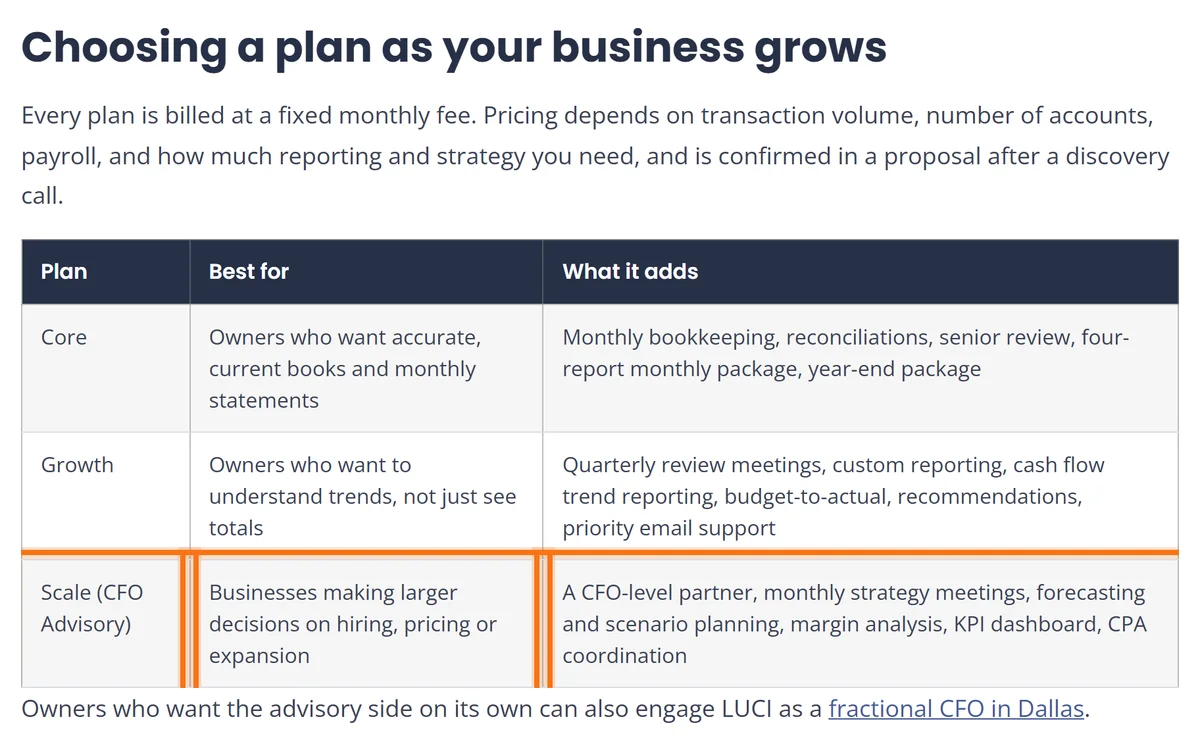
- Core covers monthly bookkeeping and reconciliations, senior review of the financials, a monthly Executive Summary with Profit & Loss, Balance Sheet and Statement of Cash Flows, a year-end package for your tax preparer, and email support.
- Growth adds quarterly review meetings, custom reporting, cash flow and trend reporting, budget-to-actual reporting, observations and recommendations, and priority email support.
- Scale (CFO Advisory) adds a CFO-level partner in major decisions, monthly strategy meetings, a monthly financial narrative, forecasting and scenario planning, pricing and margin analysis, a KPI dashboard and coordination with your CPA.
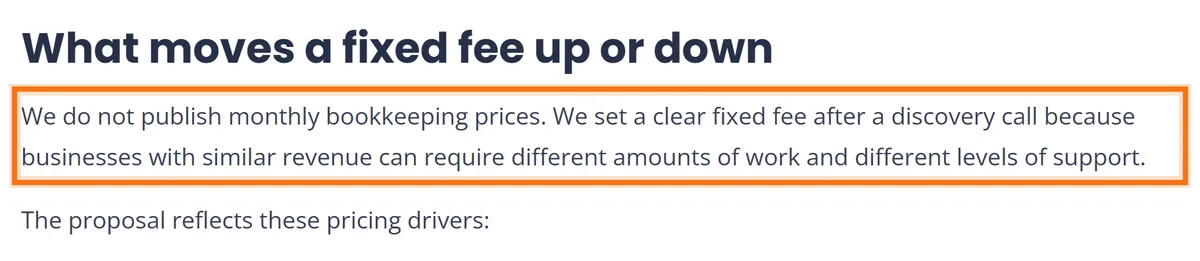
Each tier is a fixed monthly fee set after a discovery call, based on transaction volume, number of accounts, payroll and the reporting you need. We don’t publish monthly prices because a standard figure would be wrong for most of the businesses reading it. Onboarding is a one-time fixed fee stated in the proposal. If your books need significant cleanup, you get a separate fixed-fee proposal for that work before any of it begins. Payroll, sales tax, 1099s and tax preparation are optional add-ons. Engagements start with a 3-month commitment and then run month-to-month. Full details are on our services and pricing overview.
Two prices are published. The Financial Review & Assessment is $597: a 60-minute review of your QuickBooks file that ends with a prioritized action plan, whether or not you hire us afterward. Business Formation & Financial Setup starts at $1,500 for new businesses.
How to judge value, reviews and responsiveness when comparing firms
Price is only useful next to what it buys. When you compare quotes from firms in Dallas, Plano or elsewhere in DFW, ask each one the same questions:
- Is the fee fixed, and exactly what does it cover each month?
- Who does the work, and does anyone senior review it before I receive it?
- What happens if my bookkeeper leaves or is out for a month?
- How quickly do you respond to email, and when can I get a call?
- By what day of the following month will my statements be ready?
- What is extra: cleanup, payroll, sales tax, 1099s, meetings?
- How long is the commitment, and how do I leave?
For reviews, read what clients say about responsiveness and accuracy, not just the star count, and ask a shortlisted firm for a client reference in a business like yours. If you are in Collin County, our page on bookkeeping for Plano businesses covers how we work with owners there.
Frequently asked questions
How much does bookkeeping cost for a small business in Dallas?
It depends on transaction volume, the number of accounts to reconcile, payroll, industry requirements and how much reporting you want. A simple sole proprietorship and a multi-location practice can need very different amounts of work. Most firms quote after a short call so the price matches your actual scope.
Why doesn’t LUCI publish monthly bookkeeping prices?
Because the right fee depends on your volume, accounts, payroll and reporting needs, a published figure would be inaccurate for most businesses. LUCI gives you a fixed-fee proposal after a discovery call instead. The $597 Financial Review and the Business Formation starting price of $1,500 are published.
Is flat-fee bookkeeping better than hourly billing?
For ongoing monthly work, a flat fee usually is, because your cost is predictable and you can ask questions without worrying about the clock. Hourly billing fits occasional or irregular projects better. With either model, make sure the scope is written down.
What does a cheaper bookkeeping service usually leave out?
Lower-cost plans typically cover categorization, basic reconciliations and standard statements. Cleanup, accrual adjustments, payroll, sales tax, custom reporting, senior review and advisory meetings are often excluded or billed separately. That can be fine for a very simple business but limiting for one that is growing.
Are there setup or onboarding fees?
At LUCI, onboarding is a one-time fixed fee scoped in your proposal and typically takes 2–4 weeks. If the books need significant catch-up, that is quoted as a separate fixed-fee project before work starts, so you know the full cost in advance.
Do I have to sign a long contract?
No. LUCI engagements begin with a 3-month initial commitment and then continue month-to-month. The first three months cover onboarding, any cleanup and establishing accurate baselines.
For how LUCI itself sets a fixed monthly fee and what each service level includes, see our bookkeeping pricing page.
Get a fixed-fee proposal for your business
The fastest way to know what bookkeeping will cost is to describe your business to someone who prices it for a living. Schedule a consultation with LUCI and we will send a clear fixed-fee proposal after the call. If you want an independent look at your books first, book the $597 Financial Review, or call 214-233-5454.