


Short answer: Form 1099 is how a business tells the IRS what it paid people who are not its employees. For payments made in 2026, a Dallas small business generally files Form 1099-NEC for every contractor it paid $2,000 or more for services (the old threshold was $600), gives the contractor a copy and files with the IRS by January 31, and must e-file once it has 10 or more information returns.
Key takeaways
- Form 1099-NEC is for contractor services; 1099-MISC is for rent, royalties, attorney proceeds and other payments.
- The NEC and MISC reporting threshold rose from $600 to $2,000 for payments made after December 31, 2025.
- Collect a Form W-9 before the first payment, not in January.
- Card and payment-app payments are reported by the processor on Form 1099-K, not by you.
- Late or missing 1099s cost $60 to $340 per return, more for intentional disregard.
This guide explains the 1099 rules in plain terms for small business owners in Dallas–Fort Worth and across Texas: which form applies, what changed for 2026, the deadlines, how to file and how to stay out of penalty territory. It is general information from IRS sources, not tax advice for your specific situation; your tax preparer has the final word.
What is IRS Form 1099? The 1099 form explained
A Form 1099 is an information return. It does not calculate any tax. It reports a payment so that the IRS can match what the payer deducted with what the person paid reports as income. When your business pays an independent contractor, a landlord or a law firm, the 1099 is the paper trail for that payment.
The easiest way to see where it fits is to compare it with Form W-2. A W-2 goes to an employee: you withheld income tax and Social Security from their pay and you report wages. A 1099-NEC goes to a contractor: you withheld nothing (in the normal case), and the contractor pays their own income and self-employment tax. Whether someone is an employee or a contractor depends on how the work is controlled, not on what the paperwork says, so get that question right before the first payment.

Types of Form 1099 a small business sees
There are more than a dozen forms in the 1099 series, but a typical Dallas service business deals with only a few. Some you file because you paid someone; others you receive because a bank, broker or payment processor paid you. The table sorts them out.
| Form | What it reports | Who files it | Threshold (2026 payments) | Due dates |
|---|---|---|---|---|
| 1099-NEC | Pay for services by a non-employee: contractors, freelancers, consultants, attorney fees | Your business, as the payer | $2,000 or more to one payee in the year | Recipient and IRS: January 31 |
| 1099-MISC | Rents, royalties, prizes and awards, gross proceeds paid to an attorney, other income | Your business, as the payer | Rents and most boxes: $2,000; royalties: $10; attorney gross proceeds: $600 | Recipient: January 31; IRS: February 28 on paper, March 31 electronically |
| 1099-K | Payments you received by card or through payment apps and online marketplaces | The payment processor or platform | Over $20,000 in more than 200 transactions (platforms may send one below that) | You receive it; match it to your books |
| 1099-INT / 1099-DIV | Interest and dividends your business or you earned | Your bank, credit union or broker | Generally $10 or more | You receive it early in the year |
| 1099-B / 1099-R | Sales of securities; retirement plan and IRA distributions | Your broker or plan administrator | Any reportable sale or distribution | You receive it; give it to your tax preparer |
How to read this table: the first two rows are the ones you are responsible for filing. The rest arrive in your mailbox or portal and need to be matched to your books, especially the 1099-K, which shows gross card sales before refunds and fees. If a 1099-K total does not tie to the revenue in QuickBooks, find out why before your return is prepared.
IRS 1099 rules: who has to file
The basic rule is short. You file a Form 1099-NEC or 1099-MISC when all of these are true:
- You paid the money in the course of your trade or business (not a personal payment, such as a contractor who remodeled your home).
- The payee is not your employee.
- The payee is an individual, a partnership or an LLC taxed as one of those, or an estate. Most payments to corporations are exempt.
- The total paid to that payee during the year reached the threshold for that type of payment.
- You paid by check, cash, ACH, wire or similar, not by credit card or through a payment app.
Two exceptions trip up a lot of owners. Payments to attorneys for legal services are reported even when the law firm is a corporation, and so are payments for medical or health care services. And an LLC is not automatically exempt: a single-member LLC is usually reported under the owner’s information, so the Form W-9 is what tells you how to treat it.

What changed for 2026: the $2,000 threshold
For payments made in 2026 and later, the threshold for Form 1099-NEC and most 1099-MISC boxes is $2,000 per payee per year, up from $600. The change came from federal legislation passed in 2025, and the IRS instructions now reflect it. The $600 threshold still applies to payments made in 2025, which were reported in early 2026.
Three practical notes for the 1099s you file in early 2027:
- Track by payee, not by invoice. A contractor paid $900 three times has been paid $2,700, which is over the threshold.
- Keep collecting W-9s from everyone. You will not know in March who will cross $2,000 by December, and the W-9 is also what protects you from backup withholding questions.
- Some amounts did not move. Royalties are still reported at $10 and gross proceeds paid to an attorney at $600.
1099 deadlines for 2026 payments
Form 1099-NEC is due to both the contractor and the IRS by January 31; there is no later IRS date for it. Form 1099-MISC is due to the recipient by January 31 and to the IRS by February 28 on paper or March 31 electronically. When a deadline lands on a weekend or legal holiday, it moves to the next business day. January 31, 2027 is a Sunday, so the 1099-NEC deadline for 2026 payments is Monday, February 1, 2027.
Working backward from that date, a sensible calendar for a Texas small business looks like this: confirm every contractor’s W-9 in November, close and reconcile December in the first week of January, review the 1099 vendor list by mid-January, then file. Our year-end preparation checklist for Texas small businesses puts these steps next to the Texas franchise tax and payroll dates.
How to file Form 1099: e-file or paper
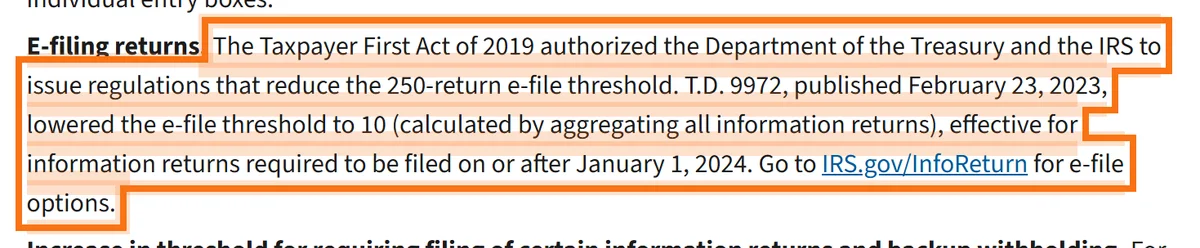
If your business files 10 or more information returns in a calendar year, counting all types together, you must file them electronically. A business with six contractors and five employees has 11 returns (six 1099s and five W-2s), so it must e-file.
There are three common ways to do it:
- IRIS, the IRS Information Returns Intake System: a free online portal for e-filing Forms 1099. It needs a one-time application for access.
- Your accounting or payroll software: QuickBooks Online and most payroll providers can prepare and e-file 1099s from the vendor data you already keep, often for a fee per form.
- Paper: only if you are under 10 returns. You file the official red-ink IRS copy with a Form 1096 transmittal; printed-from-the-internet copies of Copy A are not accepted.
However you file, the recipient still gets their copy by the due date, by mail or electronically if they have agreed to that.
1099 penalties for late or missing forms
| When the correct return is filed | Penalty per return | Yearly maximum for a small business |
|---|---|---|
| Within 30 days after the due date | $60 | $244,500 |
| 31 days late through August 1 | $130 | $698,500 |
| After August 1, or never filed | $340 | $1,397,000 |
| Intentional disregard | $690 | No maximum |
What this means for you: the penalty applies per form, and separately to the IRS copy and the recipient copy, so ten missed contractor forms can easily cost several thousand dollars. The fix is cheap by comparison: a W-9 on file for each payee and a vendor list reviewed before January. Figures are from the IRS information return penalties page; small business means average annual gross receipts of $5 million or less.
How to correct a 1099
Mistakes happen: a wrong amount, a misspelled name, the wrong box. To fix one, prepare a new form with the CORRECTED box checked at the top, enter the right information, and send it to the recipient and the IRS the same way you filed the original. If you e-filed, your software or IRIS has a correction function. If you filed on paper, include a new Form 1096. If a form should not have been filed at all, check the IRS instructions before correcting it, because the steps are different.
Habits that make 1099 season easy
- Get a Form W-9 before the first payment. The IRS suggests keeping W-9s on file for four years.
- Mark 1099 vendors in your accounting software and map each one to the right box (NEC services, MISC rent and so on).
- Pay contractors from the business account, by check or ACH, so every payment is in the books.
- Reconcile monthly. Our month-end close checklist keeps vendor payments clean all year.
- Review the 1099 vendor report in December, while there is still time to chase missing tax IDs.
How LUCI handles 1099s for Dallas businesses
For our monthly bookkeeping clients, 1099 work is part of keeping the books, not a January scramble. W-9s are collected when a new contractor is first paid, contractor payments are coded to the right accounts as they happen, and 1099s are prepared and filed at year-end as an add-on to monthly bookkeeping. Payroll and business tax preparation can be coordinated by the same team, so the 1099 totals, the payroll filings and your tax return all come from one set of reconciled books. See bookkeeping, payroll and tax support in Dallas for what is included, or QuickBooks Online bookkeeping in Dallas for how we set up vendors and reporting in the software.
LUCI Financial Solutions is a woman-owned firm based in Dallas–Fort Worth, led by LaTara Scott, MBA, and works with established service businesses across Texas and nationwide. For more year-round tax habits, read our tax tips for small businesses.
Common questions about IRS Form 1099
What is Form 1099 in simple terms?
Form 1099 is a family of IRS information returns. A business uses it to report money it paid to someone who is not its employee, such as an independent contractor, a landlord or an attorney. The payer sends one copy to the person paid and one to the IRS, so both report the same number.
What is the 1099-NEC threshold for 2026?
For payments made in 2026, a business generally files Form 1099-NEC for each non-employee it paid $2,000 or more for services during the year. Through 2025 the threshold was $600. The IRS says the $2,000 amount may be adjusted for inflation beginning in 2027.
Who is exempt from receiving a 1099?
Payments to employees (who get a W-2), payments for merchandise, payments made by credit card or through a payment app, and most payments to corporations are generally not reported on Form 1099-NEC or 1099-MISC. Payments to attorneys and payments for medical or health care services are reported even when the payee is a corporation.
When are 1099s due?
Form 1099-NEC is due to the contractor and to the IRS by January 31. Form 1099-MISC is due to the recipient by January 31 and to the IRS by February 28 on paper or March 31 if filed electronically. When a due date falls on a weekend or legal holiday, it moves to the next business day.
Do I have to e-file my 1099s?
Yes, if you file 10 or more information returns in a calendar year, counting all types together, such as 1099s and W-2s. The IRS offers a free online portal, IRIS, for e-filing Forms 1099. Businesses under 10 returns can still file on paper with Form 1096.
What if a contractor will not give me a W-9?
Ask before you pay, and keep a record of your requests. If a payee does not provide a taxpayer identification number, the IRS requires backup withholding of 24% from reportable payments. Getting the W-9 at the first payment avoids the problem entirely.
What happens if I file a 1099 late or not at all?
The IRS charges a penalty per return. For returns due in 2027, it is $60 if filed within 30 days of the due date, $130 if filed later but by August 1, and $340 after that or if never filed, with higher amounts for intentional disregard. The same penalties apply to the copy owed to the recipient.
Make next January the easy one
Monthly bookkeeping with W-9 tracking and 1099 filing for Dallas–Fort Worth businesses. See bookkeeping, payroll and tax support.